Tuesday, December 23, 2008

A Concise History of Thai Boxing

Talking about ancient sports of south East Asia, Thai boxing (Muay Thai) has a very prominent space. This way of boxing started in 15th century when Thailand had conflict with Burma. Muay Thai is fusion of classical boxing techniques with low kicks and elbow\knee strikes and grappling is also allowed. Muay Thai is one of the tourist attractions in Thailand even 17th march is celebrated as National Muay Thai Day. Muay Thai Boran (Old Muay Thai) has four branches.

Muay thasao, which deals in fast, moves to your opponent.
Muay chaiya is way of defending with the use of elbow and knees.
Muay korat means simply power.
Muay lobburee is art of using brains with smart moves.

Muay Thai Boran (old version of Muay Thai) stresses on clever moves and intelligence, but now days Muay Thai is all about strength.

With the new technologies gyms, punch bags and equipments were widely became available in decade before 1st world war and Muay Thai training developed. Now days it is one of the favorite sport in Thailand and people are getting more interested in Muay Thai training, eve small villages organizes contests and prizes are given.

There are numbers of camp training Muay Thai all over the world but training in Thailand has different meaning because of the society. One of them is suwit Muay Thai training camp located in Phuket. The training Muay Thai depends on your level, basic Muay thai training of two hours includes stretches, run, shadow boxing, skipping, clinching, pad work, cool down stretches. The size of the ring is same that is used for boxing with red and blue corners. The red corner is usually allotted to defending champion or the boxer who has advantage. Muay Thai is growing popular internationally and has been included in Asian games.

Suwit Muay Thai training camp is twenty years old and has best instructors from the country. Suwit Muay Thai training camp provides accommodation and training for each level at very low costs. Suwit Muay Thai training camp is located in Phuket which is one of the most popular places of tourist attraction in south East Asia. Whenever think of Thailand, think training Muay Thai and experience this great form of art.

Monday, December 22, 2008

Muay Thai

Muay Thai or Thai Kickboxing is referred as "the science of eight limbs" from its strength in using two hands, two shins, two knees and two elbows. Some said "NawaArwut" or the Art of nine Limbs (include Head)

Muay Thai are straightforward martial art, use strength in beating opponent with versatile skills. It is the descendant from Muay Boran. Muay Boran (Ancient boxing) was created to use in war when the warrior lost their weapon. The art of Thai weapon fighting is called "Krabi Krabong". Most of Muay Boran's techniques didn't exist in modern Muay Thai. Muay Boran can fight in every formats. With the basic of Muay Boran that was created for fighting many opponent in war. Sometimes the warriors lost their weapon They have to fight the enemy with their bared hand. Therefore Muay Boran emphasizes a brutal and powerful elbow and knee techniques, in beating the opponent as quick as they can and prepare for the next opponent in the battlefield.
Muay Boran is divided to Muay ThaSao (North), Muay Korat (Esarn or NorthEast), Muay Lobburee (Center region), Muay Chaiya (South)

There are a phrase about Muay Thai Boran that "Punch Korat, Wit Lobburee, Posture Chaiya, Faster Thasao"

Muay Korat emphasizes in strength. There are one technique call "Throwing buffalo punch". It was call like this since it can defeat the buffalo in one blow.

Muay Lobburee emphasizes in clever movements. Its strength point is the straight and turned punch.

Muay Chaiya emphasizes in posture, defending. It's difficult for opponent to attack. Muay Chaiya stress in elbows and knees.

Muay Thasao emphasizes in speed. Muay Thasao stress in speeding kick. Cause of their faster speed, this Muay Boran was call "Ling Lom" (windy monkey or Loris)

Muay Thai in present is different from the past. Muay Thai Boran (Old Muay Thai) use the wit in fighting. It's not like Muay Thai today that emphasizes in strength

Sunday, December 21, 2008

A Muay Thai Training Camp

Are you interested in visiting a Muay Thai Training Camp in Thailand? Do you want to master the art of Muay Thai for a championship fight or simply learn a new self defense technique? Either way you should arrange to join with on the many Muay Thai Training Camps in Thailand right away. But why travel all the way to Thailand to learn this martial art? This is a very common question, consider the answer below.

Right now Muay Thai is becoming an international craze with training infrastructures popping up throughout the world. So why is Thailand the place to go to learn Muay Thai? Because Muay Thai holds a special position in Thailand. While Muay Thai may have moved to other countries with top classes being taught in these countries the status of Muay Thai in Thailand is still extremely special.

While this excellent martial art started in Thailand is also enjoys a mass popularity in this country. Nearly every Thai individual is crazy about Muay Thai. The depth of this passion is important for two reasons when it comes to Muay Thai training. First there are a large number of Muay Thai events in the country which allow you to observe the techniques in action. Second no matter how successful of a Muay Thai fighter you are you are viewed highly in Thai society.

As Muay Thai becomes more popular the high status of those who practice it is being seen in other countries as well. However, the level of honor and respect you get in Thailand can't be found in any other country. This honor and respect factor can give you an edge over a regular Muay Thai Training Camp in other countries. Also knowing that you are learning an ancient martial art in its land of origin can help charge you up during your training sessions.

Another inspiring factor is the special status of Muay Thai in Thailand and the status of its players in Thai society. You will feel a depth of love and affection in Thailand that you won't get in other countries. This will help boost your own love and passion for learning Muay Thai as well. It will improve your ability to identify yourself with the Muay Thai Training Camp.

Learning Muay Thai in Thailand also allows you to take in the environment of true Muay Thai culture as well. This makes your success at Muay Thai training easier. So look into enrolling in a Muay Thai Training Camp in Thailand today. Don't waste your time looking into other Muay Thai Training Camps. Rather consider travel to Thailand where learning Muay Thai can also give you a new personality. And don't worry about a language barrier since most Thai individuals speak fluent English.
If you wnat to know about Thailand ,you can contact me : to_maymaru@hotmail.com


Friday, October 17, 2008

8 Muay Thai Routines for Advanced Workout Trainees

Although neophytes can engage into Muay Thai, this fitness training is mostly aimed upon advancers in training at the gym. For one, it is a very intense way of burning calories and developing muscles. Another one is that it entails a lot of alertness, endurance, strength and ability to punch and kick for this training to be carried on effectively.

Not to discount the capacity of beginners, these 8 Muay Thai routines for advanced workout trainees can take those men who’ve been working out for years to another level of intense workout:

1.Warm-Up. To do this, you can run, bounce or skip for 15 to 20 minutes to sweat out and awaken your body to be ready for an intensive training. Warm-up involves stretching to improve your flexibility level.

2.Running. This is to be executed so that you are able to increase stamina apart from strengthening your upper and lower legs. You can do this early in the morning for at least 20 to 30 minutes before training.

3.Shadow Boxing. To obtain the appropriate strategies in Muay Thai, you need to do shadow boxing. This means you kick and punch in front of a mirror to determine the correctness of your movements. A full range of movement is to be achieved in every angle.

4.Skipping. Just like warming up and running, skipping is to be done to increase your agility and empower your body for a higher level of endurance. Great stamina and good coordination must be achieved to effectively execute the movements involved in Muay Thai. You can skip using a skipping rope or by simply skipping without any paraphernalia. Be alert to shift from one leg to another. No way should you bounce using your two feet.

5.Free Weights. To elevate your capacity to endure the intense punches and kicks, you must do resistance training of your core muscles using free weights like barbell or dumbbells. Go for lighter weights and execute many repetitions. Training with heavy weights is best for bodybuilding stints, not boxing. Train your muscles carefully to remedy from getting yourself injured or strained.

6.Bag and Pad Routine. Practice punching on the boxing bags and pads. This will prepare you for the training proper.

7.Speed Ball. The usage of speed ball will help you improve your movement coordination and strengthen your shoulders.

8.Sparring. This is an important element in Muay Thai training as you will be able to gauge how well you’ve gone through. This drill will also teach you to control your opponent by practicing arm-locking and neck-clinching stints with your sparring partner.

If you carry on these important routines involved in Muay Thai training, you can effectively work your way to endure the different sets of kicks, punches and turns. This entire program allows you to trim down and develop muscles at the same time.

Sunday, October 12, 2008

Ancient Muay Thai(thai Boxing)

Muay Boran is the Other name of Ancient Thai Boxing. It is a traditional form of Muay Thai which is still taught and practiced in Thailand. Muay Boran is still practiced and taught in order to preserve the Boxing Techniques from Muay Thai's History before the introduction of formalized rules and the introduction of gloves in the 1930s. Muay Boran is the ancestor of the modern day Muay Thai Boxing. Most of the Facts of Muay Boran have been extinct now, many of the original records from Thailand regarding this fascinating subject were destroyed in the sacking of Ayuddhaya in 1767 and others lost in the mists of time. The late Arjarn Samai Messamarn from the Buddhai Swan Institute in Thailand was able to make a study of the Thai empty hand system using the scant resources available in Thailand. This research also took him to Burma where he was able to gain access to historical records on the subject of the Siamese systems of warfare. Using this information and the painstaking research done within Thailand, Arjarn Samai was able to document and confirm 60 Awudt Muay Boran techniques and fighting methods. Only two records of the techniques, hand-painted on parchment now exist. Arjarn Samai's son, Arjarn Werayut Messamarn recently visited England bringing with him one of these unique documents. It is believed that the Siamese people had their own styles of fighting, in each Kingdom a different style. These fighting systems have clearly been evolving for many hundreds of years and have been known under many different names such as; "Arwut Thai" (meaning Thai Weapons), "Pahuyut" (armed, unarmed combat). Much later, at the end of the Ayuthaya Period, or around the beginning of the Thonburi

Teaching Ancient Muay Thai" Period after a long history of fighting against the Burmese, King Phra Thaksin "The Great" finally pushed all invaders from the Kingdoms of Siam and with this the Chakri dynasty began. The Chakri dynasty with King Rama I on the throne, marked a period when nearly all of the separate Kingdoms of Siam joined together to become the country we now know as Thailand. At the end of the 1700's, with wars against invaders over,fighters began to compete locally, and often in front of the King to see who had the best style. Most people recognize this period in the history of Muay Thai as fighters used to wrap their hands in cotton twine. Today, people refer to this style of fighting (during this period) as "Muay Kaad Chuak" although at the time, this isn't the term people used. "Muay Kaad Chuak" began to decline around the 1920's, finally ending in 1929 with a death in the ring. Although the government of the time prohibited this style of fighting(with wrapped hands) people still continued to practice the arts and fight underground. Eventually, by introducing rules, and providing fighters with better protection, competition became safer, and the sport of Muay Thai was born. Here are some information of the techniques used: Technique 6 (Buddhai Swan) - The boxer grabs the opponent's neck twisting him from side to side, and then throwing a knee to the opponent's body, finally the boxer will push the opponent away finishing with a high kick to the opponent's neck. To clarify, the name given to the technique usually refers to an action within that technique, not necessarily the whole technique or even the end result but for instance the action of breaking (hak) the neck (kor) in Hak Kor Erawan or the action of presenting or offering something up in Hanuman Tawai Wen. From the 60 major techniques in the Buddhai Swan syllabus there are other minor techniques plus many different variations and additional moves that can follow on from the main techniques. A good example of this is the technique "GAA JIK KAI" translated Crow pecks the egg which is basically fast jabs to the opponent's face but from the jab one could choose any technique e.g. round kick (daet), front kick (teep), right uppercut (uppercut kwaa) or many others.

Besides the Buddhai Swan techniques, we have uncovered at least another 60 different techniques from various sources including Arjarn Yodthong from the Sityodthong Camp, Arjarn Panya Kraitus author of the book "Muay Thai Most Distinguished Art of Fighting", the late Khun Bunyuen Suvanatdha former head of the Amateur Muay Thai Association of Thailand and Kru Lang of the Sitpralang Camp in Ayuddhaya.

The discovery of Muay Boran in the West has taken us on a journey back through time. The modern sport of Muay Thai has been established here for nearly 30 years, we are now moving backwards and have discovered the time before sport when contests were fought for honour or freedom. It is merely a blink of the eye in time before we reach our final destination and find the mother of the Thai martial arts - Krabi Krabong.

Friday, October 10, 2008

Basic Rules of Muay Thai

Muay Thai, with its emphasis on both offense and defense as well as on stamina, is a martial art anyone can learn: men, women, young or old. With the interest in Muay Thai growing fast, martial-art schools in Europe, America and Asia have added it to their curricula. To learn it well, the player should know some basics of Muay Thai.

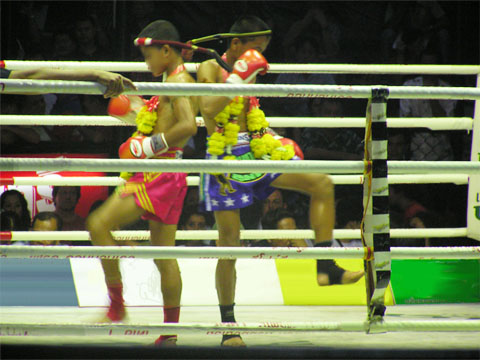
Muay Thai is fought in five three-minute rounds with two-minute breaks in between. The fight is preceded by a wai khru dance, in which each contestant pays homage to his teachers. Besides the symbolic meaning, the dance is a good warm-up exercise. You will notice that each boxer wears a headband and armbands. The headband, called mongkhol, is believed to bestow luck to the wearer since it has been blessed by a monk or the boxer's own teacher. Since Buddhism and the teacher play important roles in the life of Thais, the headband is both a lucky charm and a spiritual object. It will be removed after the wai khru dance, and only by the boxer's trainer. The armbands, meanwhile, are believed to offer protection and are only removed when the fight has ended.

A match is decided by a knockout or by points. Three judges decide who carries the round and the one who wins the most rounds, win the fight. The referee plays a very important role, since boxer's safety depends on his decision.

To one side of the ring is the band section, comprising a Javanese clarinet, drums and cymbals. They accompany the fight from the homage dance to the conclusion. The tempo goes up as the action inside the ring intensifies. The musicians are mostly old-timers who have seen just about anything, yet their music always makes the heart race faster. It is said that the tune is a siren song that the true Muay Thai devotee can never resist.

Equipment that is necessary for Muay Thai matches must be provided by the stadium. There are a stopwatch, a signal gong, a warning bell, and boxing gloves of various sizes according to the rules, equipment to provide water for boxers, and other additional personal accessories for boxers who have not prepared their own such as boxing shorts in red or blue, jock straps, surgical tape, or sacred cords. Thai boxing can be classified into two major types, the first is muay lak which puts the emphasis on caution and patience, and is very rare nowadays. The second is muay kiew which is full of tricks and feints performed to catch the opponent off guard.

Thursday, October 9, 2008

On The Path To Becoming A Muay Thai Champion

Many MMA fighters, including Mark Hominick are avid students of Muay Thai, a form of Thai Boxing known as The Art of the Eight Limbs, and is the hard martial art most commonly practiced in Thailand, so much so that it the countrys national sport. The traditional version utilizes a system of punches and kicks within a ring, similar to Western boxing methods except that the hands, shins, elbows, knees and other body parts are also used. Muay Thai can be traced back to Muay Boran, or ancient boxing, a form of combat used by Siamese Soldiers.

Later, Buddhist Monks kept up the tradition of Muay Thai as teachers of both practical and spiritual arts, preserving the techniques of Mae Mai and Luk Mai, or major and minor techniques, respectively. Punch techniques include the straight punch, the hook, the swing, the spinnng backfist, the uppercut, the jump punch, and the overhead punch. These are the most popular techniques and are favored by not only Mark Hominick, but other fighters as well.

The elbow techniques consist of the elbow slash, horizontal elbow, uppercut elbow, forward elbow thrust, reverse horizontal elbow, spinning elbow, elbow chop, double elbow chop, md air elbow strike, all of which are especially important for this martial arts form, since elbows can be used in seven different ways. These include horizontal, diagonal upwards, diagonal downwards , uppercut, downward, backward spinning, and flying.

Kicking techniques in Muay Thai include the straight kick, nutcracker kick, roundhouse kick, diagonal kick, the half shin half knee kick, spinning heel kick, down roundhouse kick , axe heel kick, jump kick, and step up kick. The two most common are the foot jab, and the roundhouse, or diagonal kick, which is similar in execution to the karate roundhouse kick.

Knee techniques are also crucial in the art of Muay Thai, and consist of the jumping knee strike, the flying knee strike, the straight knee strike, and the small knee strike. Muay Thai places a particularly heavy emphasis on conditioning, which includes shadowboxing, body weight resistance exercises, abdominal exercises , and weight training. Fighters train with coaches, using specially made pads, focus mitts, and other special gear.

Focus mitts are specifically designed to train a fighters hands speed, punch combinations, timing, punching power, defense, and counter punching. Top fighters in the sport also rely on heavy bag training, a conditioning and power exercise that helps to reinforce the techniques practiced on specially designed pads.

Mark Hominick and others rely on Muay Thai to stay at the top of their game, but anyone can learn this ancient martial art for themselves.

10 Good Tips to Do Muay Thai Training Safely

Because Muay Thai is one of the fitness programs deemed to be intense and difficult without proper training, there are several considerations one has to bear in mind to avoid complications, injuries and hang-ups. Before you can be frustrated with how it can consume all your energy, learn from the experts in kickboxing and Muay Thai in particular.

These 10 good tips to do Muay Thai Training Safely will allow you to start the training right and end it with amazing results:


1.This is a trendy and intensive workout program that advanced level of gym fanatics have embraced upon. To do it correctly, you must seek the guidance and supervision of a professional Muay Thai instructor at all times—from warm-up to your training session proper.

2.You have to get attuned to the proper Muay Thai techniques so that you can train intelligently and improve progressively.

3.By practicing at home using kicking bag or pad, you will burn bad calories and develop your endurance level at the same time. You can gauge your effectiveness as a trainee when you hit the training court.

4.Training exclusively is a no-no. You have to get the services of a professional to spot, train and correct you. You can also get your friends to train along so that it becomes a bonding session amongst you.

5.Be patient along the way because it entails about two months to master the Muay Thai techniques and stances. Unlike other cardio fat-burning training programs, It’s a very intensive and hard to grasp without consistent training.

6.You have to possess a great level of discipline so that you can train successively without quitting. This isn’t just for boxers but for those who want quicker results in losing weight. Be disciplined and focused in carrying on the routines so that you hit your targets.

7.To progress accordingly, you must train as regularly as possible. However, you must allow your body to have at least one day of rest every seven days.

8.Learn the basics before grasping on the advanced techniques. You always start with square one before heading right away to the more complicated stints. A great background of the basics will get you to the higher level quicker.

9.On your first few sessions, you have to be rendering the routines slowly but surely. Focus on the movements first before dwelling too much on the intensity and degree of execution.

10.You have to gain utmost balance, muscle harmony, appropriate timing and preciseness of execution in order to train in Muay Thai with best results.

Bearing these tips in mind will you jumpstart in Muay Thai without a doubt. As you step up in your speed and endurance level, you will realize that this kind of training isn’t just exclusive for boxers but also individuals who can handle intense fat-burning workout.

An Insight Into Muay Thai Kick Boxing

The exact date muay Thai kick boxing was started is hard to narrow down, but it does date back all the way to medieval times. King Nareasen made it famous in 1560 AD when he was given a chance to fight for his freedom. King Nareasan was victorious, freed, and returned home where he declared the fighting style (then called Siamese style boxing) a national sport.

The art of muay thai kick boxing is known as both a hard martial art and as "the deadly art." Muay thai kick boxing is a self defence art developed in Thailand and it enjoys immense popularity in many south-Asian countries as well. There is a wide variety of forms and styles, just like other styles of martial arts.
Muay thai kick boxing is the national sport of only Thailand, though it has become popular in many other countries. The main point that separates muay thai kick boxing from western developed boxing is the fact you are allowed to use shins, knees, elbows and fists. The fighter is able to use 8 parts of his body to strike his opponent.

About 50 years ago, boxing gloves where introduced - before this it was more common to bond smashed shards of glass to a rope binding around the hands. This practice was ended when international muay thai kick boxing tournaments began. This ultimate full-contact martial art, builds stamina and mental toughness. In Thailand, every boy is mandated to learn muay thai and most girls will learn at least some basic moves.

Muay thai kick boxing is designed to be performed unarmed, as every move can be done with combinations of eight body parts. Unlike other forms of martial arts where grappling is done on the floor, the grappling done in muay thai kick boxing is done while standing. The most common techniques used while grappling are attempts to hit the opponent's stomach or head with the knees. Muay thai kick boxing appears as an extremely violent form of martial arts. Contrary to how it appears, it actually provides you with anger control and a constant strive for peace and unity.

Muay Thai-thai Kickboxing

Muay Thai, or Thai Boxing has been described as the world's toughest ring sport and is one the most lethal forms of martial art. Also known as "The Science of Eight Limbs", it's a hard-style of martial art that also employs the use of the head, elbows, knees and shins as weapons. Although most of the world knows it to be exclusively from Thailand, it comes from the term Muay Boran and is also practiced in other countries in the region of South East Asia and has different names depending on the country. Malaysians call it Tomoi, Muay Lao in Laos, Lethwei to Burmese and Pradal Serey in Cambodia.

Muay Thai has its roots in the Siamese Army in ancient times and bouts during those times had no time limit and few rules. Only in the late part of the 20th century were gloves, ring times and a clear set of rules were adopted.

Target points for Muay Thai punches include the area above the ear, the jaw, the area covered by the upper lip (philtrum), the clavicle, floating ribs and the solar plexus. Punching techniques or Chok are similar to Western boxing: the straight punch (Mud Trong), Mud Wiang San or hook, the swing- Mud Wiang Yao, the uppercut Mud Seuy, Cobra Punch or Kra-dod Chok, and the undercut or Mud Hook. One Muay Thai punching technique absent in Western boxing is the spinning backfist or Mud Wiang Glub and can be a very effective surprise attack.

Teh, or kicking techniques are an essential part of Muay Thai combat. It consists of the straight kick Teh Trong, the roundhouse Teh Tud, diagonal kick Teh Chiang, the shin-knee kick Teh Krueng Kheng Krueng Kao, the down roundhouse kick Teh Kod, the axe heel kick Teh Kao, jump kick Gra-dodeh Teh, step-up kick Kha Yiep The, and the spectacular spinning heel kick Teh Glub Lang. The dangerous Neb or pecking kick is an often executed Muay Thai kick and is very similar to the straight kick. The tip of the foot or ball is used to dig into the target area which can include the outer part of the thigh, the shins and the knee. It's mostly used to stop and opponent's forward moves.

Clinching in Muay Thai involves putting one's hands behind the head of the opponent and pulling it downwards. It is during these clinches that Tee Kao or knee techniques are used to strike the torso or more devastatingly, the jaw. The different knee strikes are the Kao Trong or straight knee strike, the Kao Chiang or diagonal knee strike, Kao Kong curving knee strike, Kao Tud horizontal knee strike, Kao Tod knee slap, Kao Youwn knee bomb, Kao Yiep step-up knee strike and the Kao Loi or flying knee strike.

Traditional Muay Thai training methods were grueling and literally took blood,sweat and tears to endure. It involved extreme conditioning of the legs by with repeated kicks against a banana tree. This toughens the shin area making it invulnerable to abuse in the ring.

Monday, October 6, 2008

Basic Muay Thai Techniques

The Martial art of Muay Thai has its own unique techniques. It consists of the use of nine weapons. The head, fists, elbow, knee and feet are collectively known as Na-wa arwud. But today the use of head is no longer allowed in the Muay Thai fights. In Muay Thai small amount of grappling is used (The Clinch) for both defending and attacking purpose. Muay Thai techniques are divided into two groups: Mae Mai or Major techniques and Luk mai or Minor techniques. All techniques in Muay Thai use the entire body movement, rotating the hip partially or fully with every punch, kick and block. This is the reason which sets Muay Thai apart from other forms of martial art.

Punching Techniques: ( Chok)

Straight punch = Mud Dhrong

Hook = Mud Wjang San

Swing = Mud Wjang Yao

Spinning Back fist = Mud Wjang Glab

Upper Cut = Mud Seub

Cobra Punch = Kra-Dod Chok

Over Head Punch = Mud Khouk

The judges in Muay Thai fights scores less to the fighters for the punching techniques as they are generally less effective and powerful than kicks or knee strikes. Body punching is also used less in Muay Thai as it exposes the fighters head to the strikes of knee or elbow from the opponent.

Elbow Techniques: (Dhee Sork)

Elbow Slash = Sork Dhee

Horizontal Elbow = Sork Dhad

Upper Cut Elbow = Sork Ngad

Forward elbow Thrust = Sork Poonk

Reverse Horizontal elbow = Sork wjang Glab

Spinning Elbow = Sork Glab

Elbow Chop = Sork Sap

Double Elbow Chop = Sork Glab Koo

Mid Air Elbow Strike = Gra-Dode Sork

The elbow is used in seven ways in Muay Thai, horizontally, diagonal upwards, diagonal downwards, uppercut, downward, backward spinning and flying. The elbow is also used from the sides as a finishing move or to cut the opponents' eyebrow so that he bleeds. Bleeding blocks the vision and also affects the fighter's performance.

Kicking Techniques: (Dhe)

Straight Kick = Dhe Dhrong

Nutcracker Kick = Dhe Paa Maak

Round house Kick = Dhe Dhad

Diagonal Kick = Dhe Chivang

Half-spin, half knee kick = Dhe Krueng Kheng Krueng Kao

Spinning hill Kick = Dhe Glab Lang

Down Round house kick = Dhe Kod

Axe Hill Kick = Dhe Khouk

Jump kick = Gra-Dode Dhe

Step Up Kick = Yiep Dhe

The most common kick in Muay Thai are Foot Jab (Theep) and the Kick (Tae), upward in the shape of a triangle targeting the ribs and arms (Chieng). This angle kick in Muay Thai has been adopted by many other forms of martial arts as it is very effective. The round house kick is almost similar to the kicks used in karate or taekwondo. Many Muay Thai fighters also uses a counter rotation of his arms to enhance the power of his kick. A Muay Thai fighter is always taught to hit with his shin. Although the shin is very sensitive for an untrained person the shin is the strongest part of the leg than the foot as it contains fine bones and is much weaker.

Knee Techniques: (Dhe kao)

Straight Knee Strike = Kao Dhrong

Diagonal Knee Strike = Kao Chijang

Curving Knee Strike = Kao Kouwng

Horizontal Knee Strike = Kao Dhad

Knee Slap = Kao Dhob

Knee Bomb = Kao Youwn

Flying Knee Strike = Kao Loi

Step up Knee Strike = Kao Yiep

Other Knee Techniques: - Kao Dode: (Jumping Knee Strike) Jump on one leg and strike with that legs knee. - Kao Loi: (Flying Knee Strike) Take step(s), jump forward and off one leg and strike with that legs knee. - Kao Tone: (Straight Knee Strike) Thrusts it forward. Not upward unless the fighter is holding opponents head down in a clinch and intend to knee upward into the face. - Kao Noi: (Small knee Strike) Hitting the inside upper thigh (above the knee)of the opponent while clinching.

Foot Thrust Techniques: (Theep)

Straight Foot Thrust = Teep Dhrong

Sideways Foot Thrust = Teep Kang

Reverse Foot Thrust = Teep Glab Lang

Slapping Foot Thrust = Teep Dhob

Jumping Foot Thrust = Gra-Dode Teep

It is also known as 'Push Kicks' and is commonly used in Muay Thai. It is mainly used to attack opponents' attack, and get the opponent off balance.

Fighters in The Arm Clinch Position:

There is a difference in Muay Thai from the western Boxing. During the arm clinch position the fighters are separate in western boxing; however they are not in Muay Thai. There are several clinching techniques in Muay Thai including:

- Arm Clinch

- Side Clinch

- Low Clinch and

- Swan Neck.

Defensive techniques against attack:

It as categorized into six groups:

1. Blocking: Defenders hard block to stop a strike in its path, so preventing it reaching its target.

2. Redirection: Defenders soft parries to change the directions of a strike so that it misses its target.

3. Avoidance: Moving a body part swiftly out of the way or range of a strike, making the position of the opponent for a counter strike.

4. Evasion: Moving the body out of the way or range of a strike.

5. Disruption: Pre-aiming an attack.

6. Anticipation: Defender catching a strike or countering it before it strike


Article Tags: Muay Thai Techniques, Basic Muay Thai Techniques

Article Source: http://www.articlesbase.com/hobbies-articles/basic-muay-thai-techniques-448580.html

Author: Jirasak Phuriphanvichai

Monday, June 23, 2008

Learning to Fight in Phuket-Thailand

Mixed martial arts or MMA is a combination of the most effective forms of fight sciences like Muay Thai, boxing, and jiu-jiitsu. The popularity of MMA based programing on television and cable like the Ultimate Fighting Championship, King of the Cage, and Cage Rage have fueled the expansion of training camps and schools throughout the world.

Today, fighters, young and old, travel around the world searching for training that will make the the next "Ultimate Fighter." You want to learn Jiu-Jitsu, then head for Brazil. Looking for boxing skills then you might try the U.S. And if you are looking for Muay Thai, there is no better place than Thailand; the home of Muay Thai and the national sport of Thailand.

From one end of the country to the other, Muay Thai is the pride of the Thai people. The fight sport has become popular around the world and now boasts organizations in more than 35 countries promoting tournaments, fights, and amateur and professional titles. For years, martial arts enthusiast and athletes have ben coming to Thailand to learn the science of eight limbs from professional Thai fighters. With the explosion in popularity of MMA in the rest of the world, and here in Thailand, there is a new breed of fighter making his way to Asia and the land of smiles.
MMA fighter's are quickly learning that Thailand is the place to be to learn the secrets of striking through hardcore Muay Thai training.

Thai fighters are known for their aggressiveness, stamina, and ability to ignore pain, which are all prerequisites of the modern cage fighter. They want to learn the secrets of of the Siam warriors abilities and bring it back to the cage.
In 2001, MMA programming on in Thailand took the country by storm, and is now one of the most popular sports viewed on cable TV. The Thai people immediately took to the sport as they quickly recognized Muay Thai as a key aspect of the ultimate fight game. If you are standing up, you are fighting Muay thai style. If you are on the ground, you are using wrestling and jiu-jitsu. The Thai people were proud to see their national sport in the world spotlight.

Starting in 2005, fighters from all over the globe were given the chance to save money and participate in comprehensive training in Muay thai and MMA in Thailand. Modern fight camps, like Tiger Muay Thai & MMA, Phuket, Thailand and Bangkok Fight Club opened their door to professional and amateurs looking to train Muay Thai and MMA all at the same place. Fighters can work their stand-up striking game with Muay Thai and then train Jiu-Jitsu to work on their ground fighting skills. Now fighters would not have to travel from one country to the next to find the training they need. Everything they needed was in one place; a great training environment in the tropics which is conducive to hardcore training, training partners with the skills needed to improve, and the ability to live and train under the same roof without going broke.

As if that was not enough, Thailand offers Muay thai fights seven-days-a-week in most big cities. It used to be difficult for most fighters to find a place to train and finally land a fight. Now fighters coming to Thailand can plan a training regimen and a fight before even arriving in Thailand. I you are in shape and are looking for a fight, head to Thailand and one of the many training camps that accept foreigners. Train for six weeks and then strap on the gloves against a Thai or another foreign fighter. You will head back home with experience and the experience of a lifetime after training in Muay Thai and MMA in Thailand.

Will McNamara is a sports writer and owner of Tiger Muay Thai and MMA Training camp in Phuket, Thailand.http://www.TigerMuayThai.com

By Will McNamara

Friday, June 20, 2008

Learn Muay Thai Kickboxing

One great way to transform your personality for good is to learn Muay Thai kickboxing. It is a highly effective way to tap and boost all your hidden assets, while to shed off all the unpleasant habits, etc. that you may be having.

Let us study the Muay Thai training pattern. When you will go to learn Muay Thai, your training will have two broad divisions - a.) the body conditioning activities and b.) learning the actual Muay Thai techniques.

Why the body conditioning activities?

The basic objective of the Muay Thai training is to learn how to Muay Thai kickboxing. So this question might come in your mind that why you should go through body conditioning activities.

The reason is simple. Learning the actual Muay Thai techniques is a highly strenuous and physically demanding affair. The body conditioning activities help the trainee develop his physical and mental strength to the level that he is able to withstand that strain and hardships.

The constituents of the body conditioning activities

The main constituents of the body conditioning activities are as follows -
Running - You will have approximately 18 km running per day, divided into two slots with one each for the first and the second half. During both the halves the running will mark the beginning of other training programs.

Stretching ¬- There will be around 20-30 minutes of stretching exercises everyday. That will make your body highly receptive to the other exercises and training activities. Stretching exercises are crucial before activities that entail controlled muscular strength and flexibility. Other benefits of stretching exercises include muscular elasticity enhancement.

Shadow boxing - You have to practice shadow boxing most likely in front of a mirror. That will help you to observe and perfect your technique and aim the punches, elbows, knees, and kick at your own figure. Shadow boxing is extremely helpful in preparing your muscles before stronger physical activities.

Bag work - You will have to practice kicks on a heavy bag for around 60 minutes per day. This will help you a lot to develop conditioning and muscle memory (the body's ability to memorize or perform automatically a well rehearsed motion). Another great benefit of bag work is the development of shins.

Practicing with Thai pad - Thai pad practicing is the central point of Muay Thai training. It will help you to practice punches, kicks, knees and elbow strikes.

Rope jumping/skipping - On one hand it warms up your body. On the other hand it helps you develop your stamina and co-ordination.

Medicine ball (a.k.a. exercise ball, med ball, fitness ball) - The medicine ball will help you enhance the strength of your abdominal muscles.

Speed ball/bag - It will help you to intensify your punching skills, including hand-eye coordination, rhythm and timing.

Double end bag (a.k.a floor-ceiling bag, crazy bag, reflex bag) - The double end bag - hooked up by two thin elastic ropes to the ceiling and floor - is used as a good equipment for target practice and timing equipment.

Weight training - The weight training exercises aim at developing the strength and size of your skeletal muscles. It will actually have a positive effect for your overall health.

Body weight resistance exercises - It will include push-ups, squats, squat thrusts, pull-ups, dips, etc. They will result in developing your athleticism (balance, body control, co-ordination).

Weight loss - a main benefit of the body conditioning activities
One of the main benefits of the body conditioning activities will be a huge weight loss. The tough physical exercises will help you to shed every bit of extra weight.
The other benefits of the Muay Thai training as a whole -

The other benefits of the Muay Thai training as a whole include the followings -

Diet regime - You have to follow a strict diet regime while you learn Muay Thai kickboxing. And naturally it will have various positive results. For example, it will also help you a lot in shedding your weight. Moreover, a healthy diet is also helpful for other health matters like cholesterol factors, etc.

De-addiction - While you learn how to Muay Thai kickboxing, you will have to stay away from all sorts of addictions like alcohol, smoking, etc. This will effectively help you to de-addict all sorts of addictions you have, if any.

Self-defense skills - The Muay Thai training will teach you some great self-defense skills. These skills will be a great asset for you, even if you never compete in any Muay Thai fight.

Sound physique - A significant outcome of the training will be a great and enviable physique. That is undoubtedly an asset irrespective of your profession, lifestyle, etc.

An extreme self-confidence - Mastering the tough Muay Thai techniques will elevate your self-confidence to an extreme height. You will discover your hidden power, and will recognize the real potential and talent that you stand for.

So you can see how beneficial it is for you to learn Muay Thai kickboxing. It not only trains you in a great martial art, but also presents you with various other positive sides. It helps you to discover your real talent and power.

It helps you to develop highly beneficial habits (like an effective diet) while cutting down harmful habits like smoking, alcohol, etc.

In a nutshell, it gives you a new, dazzling personality ensuring a new life. From a so-called ordinary person, you turn into an outstanding and attractive personality.

So do not waste your time anymore. Enroll yourself with a good Muay Thai training school, and start learning this great invention of mankind.

by Shin Chang

Thursday, June 19, 2008

Muay Thai In Thailand

Learning Muay Thai in Thailand is always a special experience.

Today Muay Thai might have been become very popular in various other countries as well, resulting into top level training infrastructures in those countries.

However, the training experience in no other country can be matched with that in Thailand. It is not a question of training facilities or infrastructure, but of the ambiance.

Thailand is the country that gave birth to Muay Thai. And from the early days of its birth to date this great martial art has enjoyed immense popularity, craze and passion in Thailand.

True, today public craze for Muay Thai can be witnessed in other countries as well. But the enthusiasm and madness found in Thailand is unparalleled. Virtually every second Thai just eats, sleeps and drinks Muay Thai. This great art of fighting is a quintessential part of the Thai culture, enjoying almost a demi-god status in the Thai society.

The Thais’ passion for the sport is reflected in the huge public craze enjoyed by every Muay Thai fight in every Muay Thai event. All the successful Muay Thai fighters enjoy a position of high status, glamour and recognition. They enjoy a huge load of love and affection that nobody can overlook.

This unique level of love, craze and madness has given a special status to Muay Thai in Thailand. You can certainly witness public craze about this sport in other countries. But that craze comes nowhere near what you will witness in Thailand.

This unique ambiance makes learning Muay Thai in Thailand an outstanding experience. You will always have the feeling of learning the art on the soil of its origin. It alone will give you a spectacular charm and pleasure, adding enchantment to your training.

Where in Thailand will you train?

There are a huge number of Muay Thai gyms in Thailand. Apart from the capital Bangkok, there are many a gym in other cities as well. For example, you can learn Muay Thai boxing in Phuket in Thailand

No communication problem

Do not get tense about having any language problem. You are not supposed to learn Thai language to train in Thailand. English is quite in practice in Thailand. And no person who speaks English can have any communication problem in that country. So you will have no communication problem in Thailand despite being unable to speak a single Thai word.

So go ahead

So why should you wait anymore? Spot a quality gym in Thailand, and join it at the earliest.

By Shin Chang

Monday, June 16, 2008

Muay Thai Training Techniques

Muay Thai is a Thai mixed martial art form. It has many techniques of fighting. While using Muay Thai techniques, also known as "Mae Mai Muay Thai," fighters use the entire body including fists, elbows, shins, feet and knees.

The basic Muay Thai training techniques include punch techniques (jab, straight right/cross, hook and uppercut), elbow techniques (horizontal, diagonal-upwards, diagonal-downwards, uppercut, downward, backward-spinning and flying) and kicking techniques (push kick, roundhouse kick, etc.). The following are some special Muay Thai techniques:


The Clinch
This technique is exclusively used in Muay Thai fights. While combating the fighter applies this technique by holding his opponent either around the neck and head or around the body. It is known as Thai clinch.
To apply the clinch, the fighter has to hold his opponent either around the neck and head or around the body. The fighter also has to press his forearm against his opponent's collar bone while his hands are around the latter's head rather than his neck.

A common clinching technique used in Muay Thai fights is to just tap the head downward then give a throw. The fighter can also throw the opponent to his left in case the latter is using a knee from the right. It can cause the opponent to lose his balance.

The Kru
This is a tough technique. A new fighter takes a lot of training and hard work to learn this technique. The technique is provided by the fighter’s Krue or Thai boxing training. The trainer makes the fighter work hard and learn the technique. It is a tradition for the fighter to express his respect to his trainer through a ritual called Wai Kru.

There are some elements that are part of Muay Thai training techniques. These include:-

•Running – A trainee has to run 18 km running per day (around 12 km in the first half and around 6 km in the second half).
•Stretching – The trainee has also to do stretching for around 20-30 minutes. It improves muscular elasticity and reduces the stretch reflex.
•Shadow boxing – This training includes around 20 minutes of shadow boxing. Shadow boxing is usually practiced in front of a mirror.


Muay Thai training takes a lot of hard work. To become a good fighter young people have to go through a lot of physical and mental strain. It takes sheer dedication, commitment, and “never-say-die” attitude that a trainee transforms himself into a sound Muay Thai fighter.


by:Shin Chang

Friday, June 13, 2008

Muay Thai Combinations You Need To Know To Win Your Fights.

I've got a confession to make. I like watching science programs and nature programs. I recently watched a National Geographic special on The Science of the Punch and learned a lot about martial arts that I hadn't considered before. I learned that the single most powerful punch – by a factor of 30% - was from good old fashioned Western boxing. I saw a lot about transferring energy from the back leg through the core of the body that I'd known before, and some really cool stuff from ninjitsu that I'd never seen before. But what impressed me most of all was watching their section on Mauy Thai, and how some of the combinations in Mauy Thay deliver the ultimate combination of economy of motion and force to the body.

This inspired me to check out some Mauy Thai instructional videos. Yeah, yeah, it's Yoshi talking about Yet Another Couch Potato Style Kung Fu Style, right? Not quite. The thing about Muay Thai instructional DVDs, since Muay Thai is, effectively, a mixed martial arts full contact sport, is that the DVDs are really about bare bones practicality. They're not going to load you up with lots of "Contemplate the caterpillar weaving its cocoon" philosophy – they get straight on with it, covering stances, blocks and traps, and how to combine them into combinations.

Muay Thai words from three basic stances – the closed stance, which is used for kicks, the side stance, which is used for traps and setting up joint locks, and the horse stance, which is designed for powerful punches, and combinations. There's a lot of emphasis in the Muay Thai instruction DVDs on good stance and good footwork; you have to be able to go from a grab-and-pull to a head grab to a knee to the sternum, and for that you need good balance.

I'll be honest – I had an easier time with this one than most will; I've worked with Wing Chung Kung Fu and jiu jutsu for years, and a lot of the concepts transfer over well; most of what I got out of Muay Thai was the focus on pure pragmatism. It's entirely about taking the block and setting up the counterstrike, be it with knee, elbow, fist or foot. I could see from the Mauy Thai instructional DVD that I got that real Muay Thai practitioners get hit a lot – there's much more contact in the DVD than I'm used to seeing in training or sparring.

Following along, I got a good workout, and was really glad it was just me and a freestanding bag rather than me and some kid who's 10 years younger than me. Seriously, that Muay Thai instructional DVD made me feel my years. My knees were aching when I was done, and I was soaked. It was a good workout, like most martial arts training is. I can say this – I'd never try this with another person without some serious protective gear on me


By:Yoshi Kundagawa

Sityodtong Muay Thai Legacy


Kru Yodtong Senanan's place in Muay Thai history is legendary. That's why just two Muay Thai academies in the United States qualify as recognized affiliates of the Thailand camp that bears his name.

The significance of Muay Thai's Kru Yodtong Senanan's recent U.S. visit may have been lost to those unfamiliar with his celebrated contributions to the ancient art. But for students and trainers devoted to the art and sport of Muay Thai, his presence was treated with the kind of reverence usually reserved for dignitaries of international distinction.

So important is Kru Yodtong's role in preserving the history culture that the Kingdom of Thailand recognized him as a "Superior Teacher of Muay Thai." With the proclamation issued directly from the Royal Family, Yodtong's place of honor as a master, teacher and conservator of the sport will be forever documented in the annals of Thai history.

On a recent U.S. trip, Kru Yodtong accompanied Yodsanan 3k Battery, a WBA super featherweight world boxing champion and just one of many titleholders from Yodtong's namesake camp - Sityodtong Muay Thai Training Camp.

Along with producing number of skilled Muay Thai champions, the camp also turns out an equally impressive number of Western-style boxing champs, all of whom are students of the master himself, Kru Yodtong Senanan.

Muay Thai Master

Born 68 years ago as Erawan Sriwaralak, Yodtong's study of Muay Thai began at a distance, as the sport was then considered too dangerous for boys under the age of 15. Still, from the time he was four, Erawan observed and studied until he was old enough to begin formal training. That training began in earnest at Detrprasit Muay Thai camp when Yodtong was 14. His natural proclivity for the art became evident early on. Fighting under the moniker "Erawan Detrprasit" to honor his camp, he had his first bout just one year later. At 17, Yodtong moved to the Senanan Muay Thai camp and competed for six years before becoming a trainer to a string of Muay Thai champions. Though there are many camps throughout Thailand that specialize in any number of techniques, the heralded success of the champions hailing from the Sityodtong Payakaroon Camp comes down to teaching refined basics.

"Sityodtong is best known for our comprehensive instruction in all basic Muay Thai techniques," Yodtong said, adding that his camp is especially known for teaching the proper techniques for the use of elbows, kicks and knees. The age restriction placed on young fighters back when Yodtong was a boy have since been removed, allowing training to begin much earlier.

In fact, many of the young fighters at Yodtong's camp are orphans, some even juvenile delinquents. Not only are they trained in the fighting arts, they are also given food and shelter and attend school as well, allowing Yodtong to train the whole person. In addition to his rigorous training regimen, Yodtong offers sage advice to young fighters: "Be a good student, become a good teacher and stay away from a path of cigarettes, alcohol and drugs. To be a good person is the most important thing."

Sityodtong Muay Thai Training Camp is located near the resort town of Pattaya Beach, about a 90-minute drive from Bangkok. In operation for over four decades, the camp has turned out a long list of champions that include Daotong Sityodtong, Gongtalanee Payakaroon, Samart Payakaroon, Yoddamrung, Khaosai Galaxy and a host of others.

The Payakaroon brothers are the two most-celebrated champions from Sityodtong. In fact, it was the Payakaroon name and reputation that literally put Sityodtong Muay Thai Training Camp on the map, thus the Camp name, Sityodtong Payakaroon. To be a stadium champion is an incredible feat. When you consider that Muay Thai is the national sport of Thailand, becoming a stadium champion can be likened to winning the Super Bowl, the World Series, being NBA champs or winning the Boston Marathon. As a result, it's easy to see how an icon like Samart Payakaroon, a four-time Lumpinee Stadium champion plus a WBC champion and his older brother Gongtalanee Payakaroon, a five-time Lumpinee Stadium champion, are held in the highest regard.

To appreciate the significance of Muay Thai and Kru Yodtong's place of prominence in bring the fighting skill to its current level of notoriety, you must first appreciate Thai culture and history. Yodtong sums up the unique entwining of Muay Thai and Thai culture this way: "As anyone familiar in Muay Thai will tell you, one can benefit from improved health, develop a sense a personal safety while also enjoying the pleasures of out culture."

Heart of the People, Sport of Kings

There are two schools of thoughts about how Muay Thai became a national sport of Thailand. Some say that during the time of the Burmese invasions of Siam (Thailand), warriors indigenous to the land fought off their would-be invaders using their bodies as weapons, thus the legend of the most-famous and revered Thai boxes, Nai Khanom Tom.

In the 1700s during the fall of the ancient capital, Burmese soldiers captured and imprisoned many Thai citizens. Among the imprisoned populace were Thai boxers. However, the King of Burma granted Nai Khanom Yom his freedom and the freedom of the other Thai boxers after he defeated nine Burmese boxers. Not only did Nai Khanom Tom destroy his capturer's elite warriors in a spectacular fight to the finish, he also defeated a boxing instructor from a neighboring city.

The other school of thought holds that Muay Thai developed as Thai people moved from China. Whether indigenous or introduced by immigrants, all agree that while much of the history of Thailand - and hence the origins of Muay Thai - were destroyed during the Burmese invasions, the emergence of Thailand and the national sport of Muay Thai go hand in hand.

The effectiveness and popularity of Muay Thai as a combat skill was further reinforced during the reign of King Naresuan, who required all Thai soldiers to train in the fighting art. Later, Phra Chao Seua, "The Tiger King," also played a role in the development of Muay Thai as the national sport of Thailand, through his support of prizefights and the creation of early 18th-century training camps. In the 2,000 years that have transpired since the earliest known occurrence of Muay Thai, the popularity of the close-combat art has exploded beyond Thailand's borders, making Muay Thai an internationally recognized sport.

Two Schools, One Name

As the art of Muay Thai is interweaved in the Culture of the Thai people, so too are the champions of the Sityodtong camp steeped in traditions of the camp founder's fighting techniques. As the sport continues to gain in popularity among Westerners, Muay Thai gyms in the United States are increasing in numbers. However, of the many gyms that can be found throughout the country, Yodtong has bestowed only two with the distinct honor of being recognized as affiliates of his legendary camp: Sityodtong USA-Boston and Sityodtong USA-Los Angeles. As Yodtong explains, "The name Sityodtong refers to students of Kru (teacher) Yodtong, my family name. Yod in Thai means above all else and tong means flag (i.e., a flag that flies above all)." Fighters from Sityodtong USA in Boston and Los Angeles represent a long line of champions who collectively are a force with which to be reckoned.

Sityodtong USA-Boston is the East Coast affiliate of Sityodtong Thailand. Owner and operator Mark DellaGrotte lived and trained at Sityodtong Muay Thai Training Camp. A current Muay Thai champion, Yod Mark's fight record includes a second-round KO at the famous Rajadamnern Stadium in Bangkok. He was also ranked tenth at Rajadamnern. Yod Mark's trainer is Kru Toy, Kru Yodtong's son. Kru Toy is also the manager of Sityodtong Thailand, and has traveled to several countries to promote and preserve his father's teachings in the art and sport of Muay Thai.

DellaGrotte's martial arts training includes Jeet Kune Do Concepts, Kali, Silat and Brazilian Jiu-jitsu. "Kru Yod Mark" has been personally appointed by Kru Yodtong to teach and promote Muay Thai around the world. His school, located in the Somerville area of Boston, has been in operation for seven years and has turned out a number of champions.

The other school in the United States that has the honor of being recognized as an affiliate of his Thailand camp is Sityodtong USA-Los Angeles (Sityodtong LA). The school is owned and operated by Walter "Sleeper" Michalowski and his wife, world-renowned martial artist, June Castro-Michalowski. Walter, a former Junior Middleweight Muay Thai champion, also trains and has fought for Kru Gongtalanee Payakaroon representing Sityodtong Thailand.

Michalowski's training began as a young boy in the sport of boxing. He also trained in traditional martial arts and later in the Jeet Kune Do Concepts under Sifu Richard Bustillo. In fact, Michalowski met his first Muay Thai trainer, Nanfa Serchadeco, an Olympic silver medalist in Boxing and Rajadamnern Stadium champion, while training at the well-known IMB Academy (International Martial Arts and Boxing) in Torrance, California.

Michalowski's impressive list of accomplishments includes a kickboxing title and six Muay Thai belts. At his last professional fight he was featured on Thai television as the Main Event at the newly built Pattaya Stadium in Thailand. Michalowski ended the fight with an exciting first-round knockout over a formidable opponent, Phothong Sor Preapan.

Thanks to his mastery of the art and respect for the Thai culture, when he and his wife opened their Pasadena location (Pro Training, Inc.) in September 2003, Michalowski, a certified senior instructor in Muay Thai, was approached by Kru Yodtong and was asked to be the U.S. West Coast affiliate. The facility was officially anointed the West Coast affiliate of the Sityodtong Muay Thai Training Camp.

Not only have DellaGrotte and Michalowski honed their craft at the namesake bearing Kru Yodtong's name, both men understand that the art of Muay Thai is one with the Thai culture. To separate one from the other is to denigrate the art. Both Michalowski and DellaGrotte speak Thai, which comes in handy for the regular trips they make to Thailand with their students. And, by earning the honor of becoming affiliates and conservators of Muay Thai in their own right, both continue a lasting relationship with master trainer, Kru Yodtong. Most important is the humility and respect that every level of student from both camps have for the Muay Thai master whose traditions and techniques are taught under the banner of Sityodtong USA.


by: Sityodtong LA

Wednesday, May 21, 2008

Tradition of Wai Khru

One of the most important traditions of Muay Thai is Wai Khru (Paying Respect to Teachers). In order to become a fully-fledged Muay Thai fighter, a person has to pass through a series of ceremonies. First comes the Initiation as a Trainee Fighter Ceremony (Kuen Khru), in which the khru muay accepts young fighters as his students and pledges to teach them to the best of his ability. After fighters have been accepted, they must demonstrate a good conduct, diligence and endurance, in addition to training as hard as they can, following implicitly all the teacher's rules

During their apprenticeship, young fighters will experience the second type of Wai Khru ritual, the Annual Homage-Paying Ceremony(Wai Khru Prajam Pee). This annual ceremony is usually held on Muay Thai Day (March 17) for young fighters to pay respect to their teachers and souls of teachers long passed away. The ceremony then progresses to the students honoring all the teachers present, who will mark sacred symbols on the fighters' forehead in order to bestow prosperity and success upon them - a custom known as jerm. The ceremony culminates with the third form of Wai Khru, the Ritual Dance of Homage (Wai Khru Ram Muay) performed by the fighters as a mark of respect.
It is only when fighters have passed all these three milestones (initiation, training and participation in contests) that they are entitled to call themselves as real Muay Thai fighters. When fighters have satisfied their teachers on all these counts, then they can participate in the fourth Wai Khru ritual, the Initiation as a Teacher Ceremony (Khrob Khru), which bestows on them the rank of khru muay and again involves a performance of the Ritual Dance of Homage.

Approaching the Ring Rites (Kuen Suu Weitee)
In ancient times, Siamese people believed in the power of incantations and protective amulets, the common belief was that everything was ruled and inhabited by unseen spirits, and that places were either blessed or cursed. Because of these beliefs, it was necessary to perform special rites before a fighter entered the ring, asking the spirits' permission to do so.

Even today, before entering the ring many fighters perform rituals. It is very much a matter of individual preference these days, with no prescribed rules. Some may kneel before the ring, others might pray with their khru muay or perform a series of repetitive movements, such as touching the ring ropes 3 times and avoiding the bottom stair before taking the first step up to the ring.

Fighters always leap over the ropes into the ring, because the head is considered to be more important than the feet and therefore it has to stay always above the feet while entering the ring, then they will go to the center and pay respect (panom muae wai) in all four directions to the spectators.

Ritual Dance of Homage (Wai Khru Ram Muay)

Wai Khru Muay Thai is a tradition which goes back to ancient times, it is not an optional ritual or reserved for special occasions: the official Muay Thai regulations specify that both fighters must perform the Wai Khru Ram Muay before each and every bout. It's a tradition in which fighters pay respect to their teachers, parents and things they hold sacred and pray for their safety and victory. The ritual has been developed in different ways, in different regions, even under different teachers and therefore it is theoretically impossible for two fighters to perform identical Wai Khru.

The Wai Khru is graceful and aesthetic ritual, both practical and spiritual. In a practical sense, it functions as a final pre-fight warm-up and gives the fighter some time alone before the fight to collect his thoughts. It can be divided into three main sections:

The Royal Homage Sequence
This was originally intended to show devotion to the King, going back to the days when fighters were selected to display their skills in front of him. It has three subsections: Prostration, Outstretched Arms and Act of Homage.

The Kneeling Sequence
This section is performed in a kneeling posture, one knee on the ground and the other leg out in front. the fighter pivots around on the spot to repeat the same sequence facing all four sides of the ring, a tradition which comes from Krabi Krabong.
The Standing Sequence
In this section, the fighters go out from the center of the ring in one direction, to perform the Dramatic Interlude. Some fighters imitate the motions of "Rama Shooting an Arrow" from the Ramakien, a hunter, a soldier, or an executioner. Some fighters use this ritual to attempt to scare their opponents, commonly by stomping around them. But in a deeper sense, the fighter is expressing religious devotion, humility, and gratitude. Transcending both physical and temporal limitations, he opens himself to the divine presence and allows it to infuse his heart.

Removal of the Head Circlet (Pitee Tod Mongkon)
After the Wai Khru is completed, the fighters return to their own corners for the Removal of the Head Circlet Ritual (Pitee Tod Mongkon). The fighter stands in his own corner, lowers his head and raises hands to his chest for panom mue wai pose, while khru muay standing outside of the ropes facing the fighter, raises his own hands to return the wai. A fighter maintains the posture while the teacher utters an incantation and blows three times on top of fighters' head before removing the Mongkon. On the completion of this ritual and after a review of the rules by the judge and a glove shake, the contest may begin.

Muay Thai History


The development of Muay Thai saw the transformation of the human body into a multifaceted weapon inspired by the weapons common to the time. The shin became the staff of the pike, used to block and strike. The arms became the raised twin swords of defense. The fist functioned as the jabbing tip of the spear. The elbow developed into the battle axe, used to smash and to crush. The knee, too, axed its way through enemy’s defenses. Finally, there was the transformation of the flashing foot into pike, arrow, and knife. As each part of the body became a weapon unto itself, a new close-combat fighting skill was born: MuayThai. Since its initial development, MuayThai has changed in many ways. It is now a modern sport, rather than a battlefield skill. But in its heart are carried old traditions and an ancient fighting spirit.

Muay Thai is part of the cultural heritage of the Thai people. Their histories are intertwined. But their historical development is difficult to discern clearly. When the Burmese sacked the Thai capital of Ayutthaya, the archives of Thai history were, for the most part, lost. Along with them were lost the historical accounts of the development of MuayThai. What little we do know comes primarily from the writings of Burmese, Cambodian, and early European visitors to Thailand, as well as chronicles from the Lanna Kingdom in Chiang Mai. All these sources agree that MuayThai originated to be used on the battlefield in person to person combat. As to the specific origins, however, these sources are unclear and often contradict each other.

There are, however, two main theories...

The first : suggests that the art of MuayThai developed as the Thai people migrated from China to what is now Thailand. It would have been an essential tool in the migrants’ struggle for land.

The second : theory contends that the Thai people were already settled in Thailand and developed MuayThai as a means of self defense against invasion.

Finally whichever account is correct, what is indisputable is that MuayThai was an essential part of Thai culture from its very beginnings.

The first great upsurge in interest in MuayThai as a sport and not just a military skill occurred in the Ayutthaya period during the rule of King Naresuan in 1584 CE. At that time, every soldier as well as the King himself, trained in MuayThai. MuayThai slowly evolved from its roots in the Chupasart – a warfare manual – and new techniques were developed. This development continued under the reign of King Prachao Sua, the Tiger King, who so loved MuayThai that he often fought incognito in village contests. Thailand was at peace during his reign, so soldiers were ordered to train MuayThai. Interest in the sport subsequently took off. MuayThai became the favorite pastime and sport of the Thai people, who flocked from all walks of life to MuayThai training camps. Every village staged prize fights and had its own champion.

While MuayThai has always been popular, there have been times when it has been especially popular. The reign of King Rama V was one such golden age for the sport. Many boxing camps were set up and talent scouts, under royal command, recruited fighters from around the country to fight for the King. Match makers arranged grand bouts, which were fought for large prizes and honour.


At that time, the matches were not staged in a ring as they are now. Any available space – a courtyard or village clearing, for instance – would be used. It was not until the reign of King Rama VI that the standard ring surrounded by ropes came into use, as did time keeping by the clock. Before that time, time keeping was done by floating a pierced coconut shell in a tank of water. When the shell sank, a drum signaled the end of the round.

Muay Thai has always been a sport for the people as well as a military fighting skill. Regardless of social position, the Thai people have always practiced Muay Thai. It was part of the school curriculum until the 1920s, when it was withdrawn because it was thought that the injury rate was too high. Thai people, however, have continued to practice MuayThai in gyms and clubs. The people have always followed the sport and have been instrumental in moving it from the battlefield to the stadium ring.

Thai Kings, of course, have been powerful forces in the development of the sport. One such prime mover was King Prachao Sua, or the Tiger King. He not only influenced fighting styles, but also the equipment that was used. At the beginning of his reign, the hands and forearms of fighters were bound with strips of horse hair. This both protected the fighter and inflicted more damage on the opponent. Horse hair strips were later replaced by hemp ropes or starched strips of cotton. For particular challenge matches, and with the fighters’ agreement, ground glass was mixed with glue and spread on the strips.


Changes in the sport since that time have primarily been changes in equipment rather than radical changes. For example, while Thai fighters have always worn groin guards to protect against kicks or knees to the groin (which were legal moves until the 1930s), these guards have evolved from tree bark or sea shells held in place with a piece of cloth to triangular shaped pillows tied in place, which have subsequently been replaced by the modern groin protector which was brought back from Malaysia by a Thai boxer who traveled there.

The most radical changes in the sport occurred in the 1930s. It was then that

the sport was codified and today’s rules and regulations were introduced. Rope bindings of the arms and hands were replaced by boxing gloves, a change that can be attributed to the growing success of Thai boxers in international boxing. The introduction of weight classes was also inspired by international boxing. These and other innovations – such as the organization of fights into five rounds – substantially altered the fighting techniques employed by fighters. Some techniques have disappeared.

The establishment of stadiums, instead of makeshift rings, began during the reign of King Rama VII before World War Two. During the war, they gradually disappeared only to return with a strong presence afterwards. Boxers from up-country once again headed toward fame and fortune in Bangkok. Glory could be found at stadiums such as Rajdamnern and Lumpini. With the introduction of television coverage, the popularity of the sport was enhanced. Channel 7 began broadcasting fights in colour over twenty years ago. Today four Thai television stations broadcast fights free to millions of MuayThai enthusiasts throughout Thailand.

Muay Thai truly has evolved from a battlefield art into a popular sport. It has recently been accepted as an official sport in Asian Games competition and the push is on to have it accepted as an official Olympic sport. It is becoming increasingly popular outside of Thailand and has enthusiasts and practitioners in the Americas, Australia, Africa, Japan, and Europe. The fighting tradition continues to be passed on and is spreading wide and far. The illustrious history of MuayThai is on a path to greater recognition and international popularity.