


 One of the most important traditions of Muay Thai is Wai Khru (Paying Respect to Teachers). In order to become a fully-fledged Muay Thai fighter, a person has to pass through a series of ceremonies. First comes the Initiation as a Trainee Fighter Ceremony (Kuen Khru), in which the khru muay accepts young fighters as his students and pledges to teach them to the best of his ability. After fighters have been accepted, they must demonstrate a good conduct, diligence and endurance, in addition to training as hard as they can, following implicitly all the teacher's rules
During their apprenticeship, young fighters will experience the second type of Wai Khru ritual, the Annual Homage-Paying Ceremony(Wai Khru Prajam Pee). This annual ceremony is usually held on Muay Thai Day (March 17) for young fighters to pay respect to their teachers and souls of teachers long passed away. The ceremony then progresses to the students honoring all the teachers present, who will mark sacred symbols on the fighters' forehead in order to bestow prosperity and success upon them - a custom known as jerm. The ceremony culminates with the third form of Wai Khru, the Ritual Dance of Homage (Wai Khru Ram Muay) performed by the fighters as a mark of respect.

It is only when fighters have passed all these three milestones (initiation, training and participation in contests) that they are entitled to call themselves as real Muay Thai fighters. When fighters have satisfied their teachers on all these counts, then they can participate in the fourth Wai Khru ritual, the Initiation as a Teacher Ceremony (Khrob Khru), which bestows on them the rank of khru muay and again involves a performance of the Ritual Dance of Homage.
Approaching the Ring Rites (Kuen Suu Weitee)
In ancient times, Siamese people believed in the power of incantations and protective amulets, the common belief was that everything was ruled and inhabited by unseen spirits, and that places were either blessed or cursed. Because of these beliefs, it was necessary to perform special rites before a fighter entered the ring, asking the spirits' permission to do so.

Even today, before entering the ring many fighters perform rituals. It is very much a matter of individual preference these days, with no prescribed rules. Some may kneel before the ring, others might pray with their khru muay or perform a series of repetitive movements, such as touching the ring ropes 3 times and avoiding the bottom stair before taking the first step up to the ring.
Fighters always leap over the ropes into the ring, because the head is considered to be more important than the feet and therefore it has to stay always above the feet while entering the ring, then they will go to the center and pay respect (panom muae wai) in all four directions to the spectators.
Ritual Dance of Homage (Wai Khru Ram Muay)
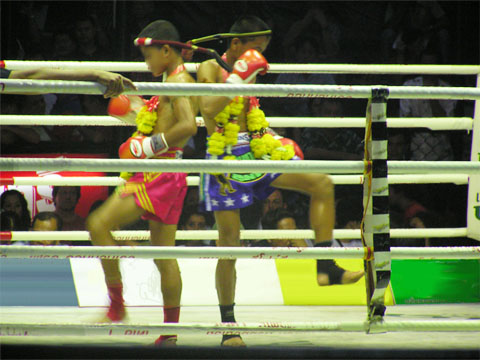 Wai Khru Muay Thai is a tradition which goes back to ancient times, it is not an optional ritual or reserved for special occasions: the official Muay Thai regulations specify that both fighters must perform the Wai Khru Ram Muay before each and every bout. It's a tradition in which fighters pay respect to their teachers, parents and things they hold sacred and pray for their safety and victory. The ritual has been developed in different ways, in different regions, even under different teachers and therefore it is theoretically impossible for two fighters to perform identical Wai Khru.
The Wai Khru is graceful and aesthetic ritual, both practical and spiritual. In a practical sense, it functions as a final pre-fight warm-up and gives the fighter some time alone before the fight to collect his thoughts. It can be divided into three main sections:
The Royal Homage Sequence
This was originally intended to show devotion to the King, going back to the days when fighters were selected to display their skills in front of him. It has three subsections: Prostration, Outstretched Arms and Act of Homage.
The Kneeling Sequence

This section is performed in a kneeling posture, one knee on the ground and the other leg out in front. the fighter pivots around on the spot to repeat the same sequence facing all four sides of the ring, a tradition which comes from Krabi Krabong.
The Standing Sequence 
In this section, the fighters go out from the center of the ring in one direction, to perform the Dramatic Interlude. Some fighters imitate the motions of "Rama Shooting an Arrow" from the Ramakien, a hunter, a soldier, or an executioner. Some fighters use this ritual to attempt to scare their opponents, commonly by stomping around them. But in a deeper sense, the fighter is expressing religious devotion, humility, and gratitude. Transcending both physical and temporal limitations, he opens himself to the divine presence and allows it to infuse his heart.
Removal of the Head Circlet (Pitee Tod Mongkon)
After the Wai Khru is completed, the fighters return to their own corners for the Removal of the Head Circlet Ritual (Pitee Tod Mongkon). The fighter stands in his own corner, lowers his head and raises hands to his chest for panom mue wai pose, while khru muay standing outside of the ropes facing the fighter, raises his own hands to return the wai. A fighter maintains the posture while the teacher utters an incantation and blows three times on top of fighters' head before removing the Mongkon. On the completion of this ritual and after a review of the rules by the judge and a glove shake, the contest may begin.


